Colchicum (/ˈkɒltʃɪkəm/ or /ˈkɒlkɪkəm/[2]) is a genus of perennial flowering plants containing around 160 species which grow from bulb-like corms. It is a member of the botanical family Colchicaceae, and is native to West Asia, Europe, parts of the Mediterranean coast, down the East African coast to South Africa and the Western Cape. In this genus, the ovary of the flower is underground. As a consequence, the styles are extremely long in proportion, often more than 10 cm (4 in). All species in the genus are toxic.[3]

Common names
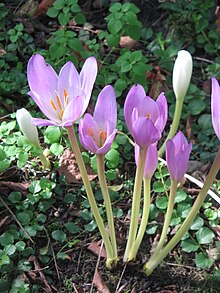
The common names autumn crocus, meadow saffron and naked lady may be applied to the whole genus or to many of its species; they refer to the "naked" crocus-like flowers that appear in late summer or autumn, long before the strap-like foliage which appears in spring.
Colchicum and Crocus look alike and can be confused by the casual observer. To add to the confusion, there are autumn-flowering species of crocus. However, colchicums have 3 styles and 6 stamens, while crocuses have 1 style and 3 stamens.[4] In addition, the corm structures are quite different—in colchicum, the corm is irregular, while in crocuses, the corm is like a flattened ball.[5] Crocus is in the Iris Family, Iridaceae.
Etymology
The name of the genus derives from Κολχίς (Colchis), the Ancient Greek name for the region of კოლხეთი (Kolkhida) in modern Georgia (Caucasus). Colchis features in Greek mythology as the land to which the Argonauts journeyed in quest of the golden fleece and where Jason encountered Medea. The Greek toponym Colchis is thought by scholars to derive from the Urartian Qulḫa, pronounced "Kolcha" (guttural "ch" - as in Scots loch).[6]
Relationships
Colchicum melanthioides, also known as Androcymbium melanthioides,[7] is probably the best known species from the tropical regions. In contrast to most temperate colchicums, the flower and leaves are produced at the same time, the white flowers usually in a small corymb that is enclosed by white bracts. Close relatives such as Colchicum scabromarginatum (Androcymbium scabromarginatum) and Colchicum coloratum (Androcymbium burchellii) have flowers with very short stalks and may be pollinated by rodents.[8]
Cultivation
Temperate colchicums are commonly grown in gardens as ornamental flowers. Species found in cultivation include:
- C. × agrippinum
- C. autumnale
- C. × byzantinum
- C. cilicicum
- C. lusitanum
- C. speciosum
- C. tenorei
There are also cultivars and hybrids such as:-
- C. 'Dick Trotter' (violet with white centre)
- C. 'Disraeli' (purple white),
- C. 'Giant' (red with white centre)
- C. 'Harlekijn' (white with purple band)
- C. 'Lilac Wonder' (lilac)
- C. 'Pink Goblet'agm[9] (violet-purple)
- C. 'Poseidon' (purple)
- C. 'Rosy Dawn'agm[10] (rose pink)
- C. 'Violet Queen' (purple)
- C. 'Waterlily'agm[11] (double, lilac-pink)
Those marked agm have gained the Royal Horticultural Society's Award of Garden Merit (confirmed 2017).[12]
In the United Kingdom, the National Collection of colchicums is maintained at Felbrigg Hall, Norfolk.
Medicinal uses and poisonous properties
Plants in this genus contain toxic amounts of the alkaloid colchicine which is used pharmaceutically to treat gout and Familial Mediterranean fever.[13] The use of the roots and seeds in traditional medicine is thought to have arisen due to the presence of this drug.[14]
Its leaves, corm and seeds are poisonous. Murderer Catherine Wilson is thought to have used it to poison a number of victims in the 19th Century. The species known to contain the most lethal amount of colchicine is C. autumnale.[15][16][17][18]
This article uses material from the Wikipedia article
Metasyntactic variable, which is released under the
Creative Commons
Attribution-ShareAlike 3.0 Unported License.