Duranta erecta is a species of flowering shrub in the verbena family Verbenaceae, native from Mexico to South America and the Caribbean. It is widely cultivated as an ornamental plant in tropical and subtropical gardens throughout the world, and has become naturalized in many places. Common names include golden dewdrop, pigeon berry, and skyflower.


Description
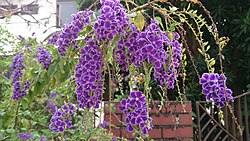

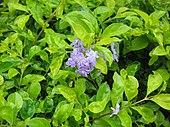
Duranta erecta is a sprawling shrub or (infrequently) a small tree. It can grow to 6 m (20 ft) tall and can spread to an equal width. Mature specimens possess axillary thorns, which are often absent on younger specimens. The leaves are light green, elliptic to ovate, opposite, and grow up to 7.5 cm (3.0 in) long and 3.5 cm (1.4 in) broad, with a 1.5 cm petiole.
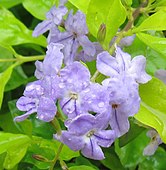
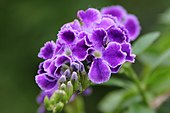
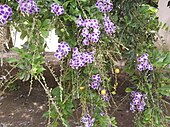
The flowers are light-blue or lavender, produced in tight clusters located on terminal and axillary stems, sometimes appearing as panicles, frequently recurved or pendulous, blooming in summer. The fruit is a small globose yellow or orange berry, up to 11 mm (0.43 in) diameter and containing several seeds.[1]
Taxonomy
The genus name is in honor of Castore Durante, a fifteenth-century Italian botanist.[2] The specific epithet erecta means "upright" in Latin. The plant is also known as D. repens, from the Latin for "creeping". The latter name was originally used to identify smaller-leaved varieties of the species.[3]
Ecology
Duranta erecta is native to the Americas, from Mexico and the Caribbean south to Brazil and Argentina. There is some debate about whether the plant is also native to the southern United States, in Florida, Louisiana, Texas, Arizona and California, or is an introduced species there, at an altitude of 40–1100 meters above sea level.[4]
In its natural state, it commonly grows in rocky or sandy coastal areas with full sun, or moister, disturbed sites inland. Prior to maturity, the plant will grow at a rate of up to half a meter per year.
Cultivation
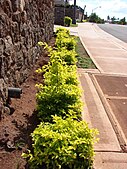
Golden dewdrop is widely grown as an ornamental plant throughout tropical and warm subtropical regions.[5] Its showy flowers and fruit make it a desirable addition to gardens, and the blossoms attract butterflies and hummingbirds.[5] There are a wide variety of cultivars available, including 'Alba', 'Aurea', 'Aussie Gold', 'Gold Mound', 'Geisha Girl', 'Sapphire Showers', and 'Variegata'.[6]
Invasive potential
The plant has been identified as an invasive species in Australia, South Asia, China, South Africa, Hawaii, Fiji and French Polynesia.[7][8] It has been introduced to other habitats but has not become invasive.
Properties
The leaves and unripened berries of the plant are toxic, and are confirmed to have killed children, dogs and cats.[9] However, songbirds eat the fruit without ill effects.[5]
Antioxidative coumarinolignoids called repenins have been isolated from Duranta erecta.[10]
In the fruit, the alkaloids, isoquinoline, and a derivative of 5,6-dihydro-7H-2-pyridine in addition to the monoterpenes durantoside I, durantoside and repenoside have been identified .
The leaves and fruits of D. repens contain a saponin glycoside and the presence of hydrocyanic acid . The durantoside has been detected in leaves and stems with leaves, in addition to the amide in the last sample. The isoquinoline is lethal to insects.
Gallery




Metasyntactic variable, which is released under the
Creative Commons
Attribution-ShareAlike 3.0 Unported License.