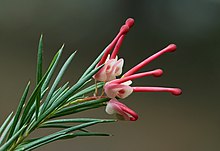
Grevillea, /ɡrɪˈvɪliə/[2] commonly known as spider flowers,[3] is a genus of about 360 species of evergreen flowering plants in the family Proteaceae. Plants in the genus Grevillea are shrubs, rarely trees, with the leaves arranged alternately along the branches, the flowers zygomorphic, arranged in racemes at the ends of branchlets, and the fruit a follicle that splits down one side only, releasing one or two seeds.


Description
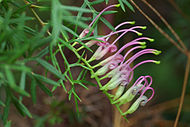
Plants in the genus Grevillea are shrubs, rarely small trees with simple or compound leaves arranged alternately along the branchlets. The flowers are zygomorphic and typically arranged in pairs along a sometimes branched raceme at the ends of branchlets. The flowers are bisexual, usually with four tepals in a single whorl. There are four stamens and the gynoecium has a single carpel. The fruit is a thin-walled follicle that splits down only one side, releasing one or two seeds before the next growing season.[3][4][5][6][7]
Taxonomy
The genus Grevillea was first formally described in 1809 by Joseph Knight from an unpublished manuscript by Robert Brown.[8][9] Knight gave the spelling Grevillia, corrected by Brown in 1810 to Grevillea in Transactions of the Linnean Society of London.[10] The genus was named in honour of Charles Francis Greville, an 18th-century patron of botany and co-founder of the Royal Horticultural Society.[10][11]
Distribution and habitat
Grevilleas grow in most habitats, although few grow in alpine areas, in swamps or saline soils. Most species are endemic to Australia but three species grow in New Guinea, (G. papuana is endemic), three are endemic to New Caledonia and one species (G. elbertii) is endemic to Sulawesi in Indonesia.[4]
Ecology
Grevilleas are good bird-attracting plants. Honeyeaters in particular are common visitors. They are also used as food plants by the larvae of some Lepidoptera species, including the dryandra moth and Pieris rapae (small white).

Uses
Use in horticulture
Many species of grevilleas are popular garden plants, especially in Australia but also in other temperate and subtropical climates. Many grevilleas have a propensity to interbreed freely, and extensive hybridisation and selection of horticulturally desirable attributes has led to the commercial release of many named cultivars. Among the best known is 'Robyn Gordon', a small shrub up to 1.5 m (5 ft) high and wide which can flower 12 months of the year in subtropical climates. The cultivar 'Canberra Gem' has gained the Royal Horticultural Society's Award of Garden Merit.[12][13]
They can be grown from soft tip cuttings from December–March (in the Southern Hemisphere) or fresh seed. Many harder-to-grow species can be grafted onto hardy rootstock such as Grevillea robusta.
There is an active Grevillea Study Group in the Australian Native Plants Society for people interested in grevilleas, both for uses in horticulture and for conservation in the wild.
Traditional Aboriginal use
Grevillea flowers were a traditional favourite among the Aboriginal Peoples for their sweet nectar. This could be shaken onto the hand to enjoy, or into a coolamon with a little water to make a sweet drink. They might be referred to as the original "bush lollies".
Drinking nectar direct from the flower is best avoided as some commonly cultivated grevillea species produce flowers containing toxic cyanide.[14][15]
Colonial furniture
A grevillea wood veneer was used on a Pembroke table, a small table with two drawers and folding sides, made in the 1790s for Commissioner of the Royal Navy, Sir Andrew Snape Hamond. The timber from which the veneer was made, referred to as 'beef wood', was sent from Port Jackson by Surgeon-General John White, who arrived in the new penal colony of Australia with the First Fleet. This table is in the collection of the National Museum of Australia in Canberra.[16]
Species
There are over 350 species which are endemic to Australia, including the following:
- Grevillea acanthifolia A.Cunn.
- Grevillea alpina Lindl.
- Grevillea annulifera F.Muell.
- Grevillea aquifolium Lindl.
- Grevillea arenaria R.Br.
- Grevillea argyrophylla Meisn.
- Grevillea armigera Meisn.
- Grevillea asparagoides Meisn.
- Grevillea aspera R.Br.
- Grevillea aspleniifolia R.Br. ex Knight
- Grevillea australis R.Br.
- Grevillea banksii R.Br.
- Grevillea barklyana F.Muell. ex Benth.
- Grevillea baueri R.Br.
- Grevillea beadleana McGill.
- Grevillea bedggoodiana J.H.Willis ex McGill.
- Grevillea bipinnatifida R.Br.
- Grevillea brachystylis Meisn.
- Grevillea bracteosa Meisn.
- Grevillea buxifolia (Sm.) R.Br.
- Grevillea bronwenae Keighery
- Grevillea caleyi R.Br.
- Grevillea candelabroides C.A.Gardner
- Grevillea candicans C.A.Gardner
- Grevillea celata Molyneux
- Grevillea centristigma (McGill.) Keighery
- Grevillea chrysophaea F.Muell. ex Meisn.
- Grevillea concinna R.Br.
- Grevillea confertifolia F.Muell.
- Grevillea crithmifolia R.Br.
- Grevillea corrugata Olde & Marriott
- Grevillea curviloba McGill.
- Grevillea depauperata R.Br.
- Grevillea dielsiana C.A.Gardner
- Grevillea didymobotrya Meisn.
- Grevillea dimidiata F.Muell.
- Grevillea drummondii (W.Fitzg.) McGill.
- Grevillea dryophylla N.A.Wakef.
- Grevillea endlicheriana Meisn.
- Grevillea erectiloba F.Muell.
- Grevillea eriostachya Lindl.
- Grevillea excelsior Diels
- Grevillea fasciculata R.Br.
- Grevillea fililoba (McGill.) Olde & Marriott
- Grevillea flexuosa (Lindl.) Meisn.
- Grevillea floribunda R.Br.
- Grevillea floripendula R.V.Sm.
- Grevillea georgeana McGill.
- Grevillea heliosperma R.Br.
- Grevillea hilliana F.Muell.
- Grevillea hookerianaMeisn.
- Grevillea huegelii Meisn.
- Grevillea humifusa Olde & Marriott
- Grevillea ilicifolia (R.Br.) R.Br.
- Grevillea infecunda McGill.
- Grevillea intricata Meisn.
- Grevillea involucrata A.S.George
- Grevillea johnsonii McGill.
- Grevillea juniperina R.Br.
- Grevillea lanigera A.Cunn. ex R.Br.
- Grevillea laurifolia Sieber ex Spreng.
- Grevillea lavandulacea Schltdl.
- Grevillea leptopoda McGill.
- Grevillea leucopteris Meisn.
- Grevillea levis Olde & Marriott
- Grevillea linearifolia (Cav.) Druce
- Grevillea longifolia R.Br.
- Grevillea manglesii (Graham) Planch.
- Grevillea microstegia Molyneux
- Grevillea mimosoides R.Br.
- Grevillea miniata W.Fitzg.
- Grevillea miqueliana F.Muell.
- Grevillea montis-cole R.V.Sm.
- Grevillea mucronulata R.Br.
- Grevillea nudiflora Meisn.
- Grevillea obtecta Molyneux
- Grevillea obtusifolia Meisn.
- Grevillea oleoides Sieber ex Schult. & Schult.f.
- Grevillea olivacea A.S.George
- Grevillea oxyantha Makinson
- Grevillea paniculata Meisn.
- Grevillea parallela Knight
- Grevillea petrophiloides Meisn.
- Grevillea pilosa A.S.George
- Grevillea pilulifera (Lindl.) Druce
- Grevillea pimeleoides W.Fitzg.
- Grevillea pinaster Meisn.
- Grevillea polybotrya Meisn.
- Grevillea preissii Meisn.
- Grevillea pteridifolia Knight
- Grevillea pyramidalis A.Cunn. ex R.Br.
- Grevillea quercifolia R.Br.
- Grevillea ramosissima Meisn.
- Grevillea refracta R.Br.
- Grevillea repens F.Muell. ex Meisn.
- Grevillea ripicola A.S.George
- Grevillea rhyolitica Makinson
- Grevillea rivularis L.A.S.Johnson & McGill.
- Grevillea robusta A.Cunn. ex R.Br.
- Grevillea rosmarinifolia A.Cunn.
- Grevillea saccata Benth.
- Grevillea scapigera A.S.George
- Grevillea sericea (Sm.) R.Br.
- Grevillea shiressii Blakely
- Grevillea speciosa (Knight) McGill.
- Grevillea steiglitziana N.A.Wakef.
- Grevillea striata R.Br.
- Grevillea synapheae R.Br.
- Grevillea tetragonoloba Meisn.
- Grevillea thelemanniana Hügel ex Endl.
- Grevillea thyrsoides Meisn.
- Grevillea triloba Meisn.
- Grevillea triternata R.Br.
- Grevillea umbellulata Meisn.
- Grevillea treueriana F.Muell.
- Grevillea vestita (Endl.) Meisn.
- Grevillea victoriae F.Muell.
- Grevillea whiteana McGill.
- Grevillea wickhamii Meisn.
- Grevillea wilsonii A.Cunn.
- Grevillea × gaudichaudii R.Br. ex Gaudich.
Five species are endemic to areas outside Australia. Three of these - G. exul., G. gillivrayi, and G. meisneri are endemic to New Caledonia while G. elbertii and G. papuana are endemic to Sulawesi and New Guinea respectively. Two other species, G. baileyana and G. glauca, occur in both New Guinea and Queensland.
Gallery


Metasyntactic variable, which is released under the
Creative Commons
Attribution-ShareAlike 3.0 Unported License.