Wisteria is a genus of flowering plants in the legume family, Fabaceae (Leguminosae), that includes ten species of woody twining vines that are native to China, Korea, Japan, Southern Canada, the Eastern United States, and north of Iran. They were later introduced to France, Germany and various other countries in Europe. Some species are popular ornamental plants. An aquatic flowering plant with the common name wisteria or 'water wisteria' is in fact Hygrophila difformis, in the family Acanthaceae.

Etymology
The botanist Thomas Nuttall said he named the genus Wisteria in memory of the American physician and anatomist Caspar Wistar (1761–1818).[1][2] Both men were living in Philadelphia at the time, where Wistar was a professor in the School of Medicine at the University of Pennsylvania.[3] Questioned about the spelling later, Nuttall said it was for "euphony", but his biographer speculated that it may have something to do with Nuttall's friend Charles Jones Wister Sr., of Grumblethorpe, the grandson of the merchant John Wister.[4] Various sources assert that the naming occurred in Philadelphia.[5]
Another source claims that the person who named Wisteria after Caspar Wistar was the Portuguese botanist and geologist José Francisco Correia da Serra, who lived in Philadelphia beginning in 1812, four years before his appointment as ambassador of Portugal to the United States. Correia became a close friend of Wistar, "took tea at his home daily, and named the vine 'Wisteria' to commemorate this friendship."[6]
As the spelling is apparently deliberate, there is no justification for changing the genus name under the International Code of Botanical Nomenclature.[7] However, some spell the plant's common name "wistaria".[8][9]
When they were introduced to France, Germany and Various other Countries in Western and Central Europe where they are known not as Wisteria but by the German Name of the plant, Glyzinien (French: Fleur de Glycine, German: Glyzinienbaum, Russian: Цветок глициний Tsvetok glitsiniy)
Taxonomy
Genetic analysis shows Callerya, Afgekia and Wisteria to be each other's closest relatives and quite distinct from other members of the tribe Millettieae. Both have eight chromosomes.[10][11]
Species
The following is a list of accepted Wisteria species:[12][13]
- Wisteria brachybotrys Siebold & Zucc. – Silky wisteria
- Wisteria brevidentata Rehder
- Wisteria floribunda (Willd.) DC. – Japanese wisteria
- Wisteria frutescens (L.) Poir. – American wisteria
- Wisteria macrostachya (Torr. & Gray) Nutt. ex BL Robins. & Fern. – Kentucky wisteria[14]
- Wisteria sinensis (Sims) DC. – Chinese wisteria
- Wisteria venusta Rehder & Wils.[15][16] (or W. ventusa Rehder & Wils.[17])
- Wisteria villosa Rehder
Description

Wisterias climb by twining their stems around any available support. W. floribunda (Japanese wisteria) twines clockwise when viewed from above, while W. sinensis (Chinese wisteria) twines counterclockwise. This is an aid in identifying the two most common species of wisteria.[18] They can climb as high as 20 m (66 ft) above the ground and spread out 10 m (33 ft) laterally. The world's largest known wisteria is in Sierra Madre, California, measuring more than 1 acre (0.40 ha) in size and weighing 250 tons. Planted in 1894, it is of the 'Chinese lavender' variety.[19]
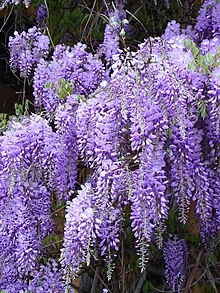
The leaves are alternate, 15 to 35 cm long, pinnate, with 9 to 19 leaflets. The flowers are produced in pendulous racemes 10 to 80 cm long, similar to those of the genus Laburnum, but are purple, violet, pink or white. There is no yellow on the leaves. Flowering is in spring (just before or as the leaves open) in some Asian species, and in mid to late summer in the American species and W. japonica. The flowers of some species are fragrant, most notably W. sinensis. Wisteria species are used as food plants by the larvae of some Lepidoptera species including brown-tail moth.[citation needed]
The seeds are produced in pods similar to those of Laburnum, and, like the seeds of that genus, are poisonous. All parts of the plant contain a saponin called wisterin, which is toxic if ingested, and may cause dizziness, confusion, speech problems, nausea, vomiting, stomach pains, diarrhea and collapse.[20][21] There is debate over whether the concentration outside of the seeds is sufficient to cause poisoning. Wisteria seeds have caused poisoning in children and pets of many countries, producing mild to severe gastroenteritis and other effects.[22][21][23]
Cultivation

(West Sussex, England)

Wisteria, especially Wisteria sinensis, is very hardy and fast-growing. It can grow in fairly poor-quality soils, but prefers fertile, moist, well-drained soil. It thrives in full sun. It can be propagated via hardwood cutting, softwood cuttings, or seed. However, specimens grown from seed can take decades to bloom; for this reason, gardeners usually grow plants that have been started from rooted cuttings or grafted cultivars known to flower well.[citation needed]
Another reason for failure to bloom can be excessive fertilizer (particularly nitrogen). Wisteria has nitrogen fixing capability (provided by Rhizobia bacteria in root nodules), and thus mature plants may benefit from added potassium and phosphate, but not nitrogen. Finally, wisteria can be reluctant to bloom before it has reached maturity. Maturation may require only a few years, as in Kentucky wisteria, or nearly twenty, as in Chinese wisteria. Maturation can be forced by physically abusing the main trunk, root pruning, or drought stress.
Wisteria can grow into a mound when unsupported, but is at its best when allowed to clamber up a tree, pergola, wall, or other supporting structure. Whatever the case, the support must be very sturdy, because mature wisteria can become immensely strong with heavy wrist-thick trunks and stems. These can collapse latticework, crush thin wooden posts, and even strangle large trees. Wisteria allowed to grow on houses can cause damage to gutters, downspouts, and similar structures.
Wisteria flowers develop in buds near the base of the previous year's growth, so pruning back side shoots to the basal few buds in early spring can enhance the visibility of the flowers. If it is desired to control the size of the plant, the side shoots can be shortened to between 20 and 40 cm long in midsummer, and back to 10 to 20 centimetres (3.9 to 7.9 in) in the fall. Once the plant is a few years old, a relatively compact, free-flowering form can be achieved by pruning off the new tendrils three times during the growing season in the summer months. The flowers of some varieties are edible, and can even be used to make wine. Others are said to be toxic.[citation needed] Careful identification by an expert is strongly recommended before consuming this or any wild plant.
Chinese wisteria was brought to the United States for horticultural purposes in 1816, while Japanese wisteria was introduced around 1830.[24] Because of its hardiness and tendency to escape cultivation, these non-native wisterias are considered invasive species in many parts of the U.S., especially the Southeast, due to their ability to overtake and choke out other native plant species.[24]

In the United Kingdom, the national collection of wisteria is held by Chris Lane at the Witch Hazel Nursery in Newington, near Sittingbourne in Kent.[25]
Art and symbolism


Wisteria and their racemes have been widely used in Japan throughout the centuries and were a popular symbol in family crests and heraldry.[26] One popular dance in kabuki, the Fuji Musume or "The Wisteria Maiden" is the sole extant dance of a series of five personifying dances, in which a maiden becomes the embodiment of the spirit of wisteria. In the West, both in building materials such as tile, as well as stained glass, wisterias have been used both in realism and stylistically in artistic works and industrial design.[27]
This article uses material from the Wikipedia article
Metasyntactic variable, which is released under the
Creative Commons
Attribution-ShareAlike 3.0 Unported License.